How to Block Adult Websites on Your Computer (6 Methods)
Free and paid methods for Windows, from DNS filters to locked blockers · Updated
You can block adult websites on a computer with a family DNS filter, Google SafeSearch, Microsoft Family Safety, a browser extension, the hosts file or a dedicated blocker. Most built-in tools are designed for a parent managing a child's account, so an adult blocking for themselves usually needs a DNS filter or a blocker that is hard to undo.
Key takeaways
- A family DNS filter is the best free method: it covers every browser and app on the device or network.
- SafeSearch filters Google results only: it does not stop a site typed in directly.
- Family Safety and Family Link are controlled by someone else: Family Link supervises a child's Google account, and Family Safety settings are managed by a family organiser.
- Every free method can be reversed in minutes: a blocker with stronger friction is the hardest option to undo.
Methods compared
| Method | What it covers | Cost | How easy to undo | Best for |
|---|---|---|---|---|
| Family DNS filter | Every browser and app on the device or network | Free | One setting | A first layer for anyone |
| Google SafeSearch | Google search results | Free | One setting, unless a parent, school or network locks it | Search results only |
| Microsoft Family Safety | Edge on a family member's account | Free | Only the family organiser can change it | Parents |
| Browser extension | One browser | Free or paid | One click | Light friction |
| Hosts file | Sites you list yourself | Free | Edit the file | A few known sites |
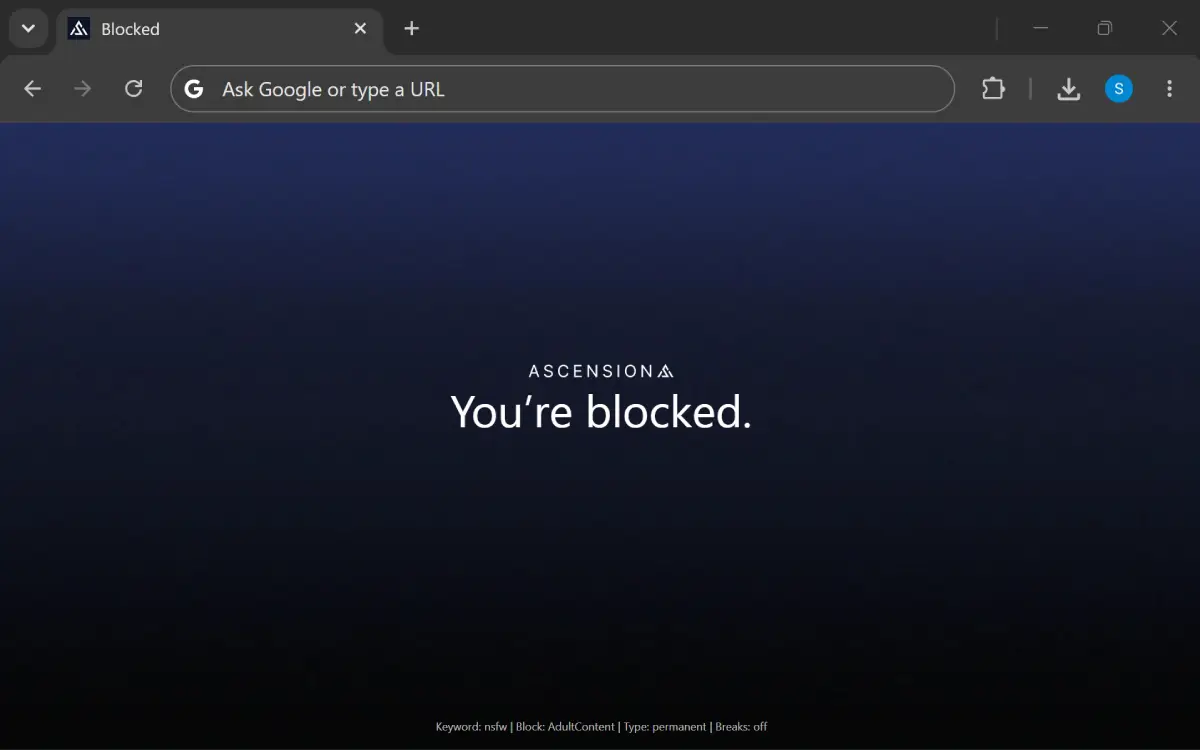
| Ascension | Six browsers & unsupported browsers blocked | 15-day trial, then paid | Locked until the date you choose | Blocks that hold |
1. Use a family DNS filter
A DNS filter blocks adult sites before they load by refusing to look up their addresses. Set it on your computer to cover that device, or on your router to cover every device on the network.
| Service | Preferred DNS | Alternate DNS |
|---|---|---|
| CleanBrowsing Family Filter | 185.228.168.168 | 185.228.169.168 |
| OpenDNS FamilyShield | 208.67.222.123 | 208.67.220.123 |
| Cloudflare for Families | 1.1.1.3 | 1.0.0.3 |
On Windows 11
- Open Settings, then Network & internet.
- Select Wi-Fi or Ethernet, then Hardware properties.
- Next to DNS server assignment, select Edit, choose Manual and turn on IPv4.
- Enter the preferred and alternate DNS addresses, then select Save.
On a router: open your router's admin page and replace its DNS servers with the addresses above. The menu differs by brand.
In Chrome: open Settings, Privacy and security, Security, and keep Use secure DNS on your current service provider or turn it off. Choosing a different provider there sends lookups past the filter.
Limits: anyone with administrator access can change the setting back, and a VPN or a different network is not filtered.
2. Turn on Google SafeSearch
SafeSearch has three settings. Filter blocks all explicit results, Blur blurs explicit images, and Off shows everything. Turn it on at google.com/safesearch or under SafeSearch in Google's search settings.
Limits: SafeSearch only works on Google Search. It does not block a website typed in directly, and an adult cannot lock it on their own account. Parents, schools and network administrators can lock it for others.
3. Use Microsoft Family Safety
Microsoft Family Safety includes Filter inappropriate websites and searches for members of a Microsoft family group. It filters in Microsoft Edge while the family member is signed in to their Microsoft account, and other browsers are blocked while the filter is on.
Limits: only the family organiser can change the settings, so it needs a second person to manage it. It is built mainly for parents.
4. Add a blocking extension to your browser
A blocking extension stops adult sites inside the browser it is installed in. Install it from your browser's extension store, then open the extension's details and turn on Allow in Incognito, because extensions do not run in private windows otherwise.
Limits: it covers one browser, another browser is unaffected, and it can be removed from the extensions page in one click.
5. Edit the Windows hosts file
The hosts file sends a website's address nowhere, so the site cannot load in any browser.
- Open Notepad as an administrator.
- Open C:\Windows\System32\drivers\etc\hosts.
- Add one line per site, for example 0.0.0.0 example.com and 0.0.0.0 www.example.com.
- Save the file.
Limits: it only blocks the exact domains you list, new sites and mirrors are not covered, and it can be edited back in a minute.
6. Use a blocker with a time lock
A dedicated blocker combines ready made adult content lists with a lock that stops you from undoing it. Ascension is a Windows blocker built for this.
- Install Ascension and add its browser extension to each browser it lists.
- Load the premade Adult Content categories for domains and keywords.
- Set the block to Always block.
- Add an Until date lock with a date far enough out.
While a block is locked, it cannot be edited, deleted or uninstalled, and a browser running without protection is closed.
Which method should you use?
For a child: Microsoft Family Safety for their account, plus a family DNS filter on the router so every device in the home is covered.
For yourself: start with a family DNS filter. If you have already switched off softer tools in a weak moment, a blocker with a time lock is the method you cannot reverse on impulse.
Frequently asked questions
Can I block adult websites for free?
Yes. A family DNS filter such as CleanBrowsing, OpenDNS FamilyShield or Cloudflare for Families blocks adult sites for free on a computer or a whole home network. SafeSearch and the hosts file are also free.
Does SafeSearch block adult websites?
No. SafeSearch filters explicit results in Google Search, but it does not stop a website typed directly into the address bar.
How do I block adult websites on my router?
Sign in to your router's admin page and replace its DNS servers with a family DNS filter, such as CleanBrowsing Family Filter at 185.228.168.168 and 185.228.169.168. Every device on the network then uses the filter.
Why does a site still load after I set a DNS filter?
The old address may still be cached. Restart the browser or run ipconfig /flushdns in Command Prompt. Also check that Chrome's Use secure DNS is not set to a different provider, and that no VPN is running.
Can I block adult websites in Incognito mode?
A DNS filter and the hosts file apply to private windows automatically. A browser extension only works in Incognito if you turn on Allow in Incognito for it.
Available on Windows 10 & 11